Build your health team inside your own AI
A trainer who knows how you slept. A nutritionist who knows how far you ran this week. A sleep coach who knows about the 4 p.m. espresso. Someone who reads your blood test before the appointment and helps you write down the right questions. Until recently, that kind of team was something only professional athletes and the very rich had.
Now most of it fits in the chat you already use. ChatGPT and Claude can read your health data with your permission, and one assistant can play every one of those roles from the same picture of you. This article is about that idea, and then, briefly, about where each piece of the picture comes from.
There is no average person
Almost every number you have been told about your health is an average. Eight hours of sleep. A daily intake of vitamin D. Coffee is fine before noon. Rest a day between hard sessions. Each one was worked out by studying thousands of people and taking the middle.
The middle is a useful starting point and a bad finishing one, because almost nobody sits exactly in it. Two people can drink the same coffee at the same hour and one sleeps fine while the other lies awake. Two runners can follow the same plan and one gets faster while the other gets injured. Two people can eat the same diet and see completely different blood results. Some of that difference is lifestyle: how you slept, how much you trained, what stress you are under. Some of it is built in, in your genes, and stays the same your whole life.
Personal advice has always been the answer to this, and it has always been expensive. A coach, a dietitian, a sleep specialist and an unhurried doctor who look at your data together is a team few people ever get.
The assistant you already have
What changed is that the most capable assistant most people have ever had is already in their pocket, and it can now read the data that makes advice personal. Not a new app with its own dashboard, but ChatGPT or Claude, the chat you already open every day, looking at your sleep, your workouts, your meals, your blood test and your genetics when a question needs them.
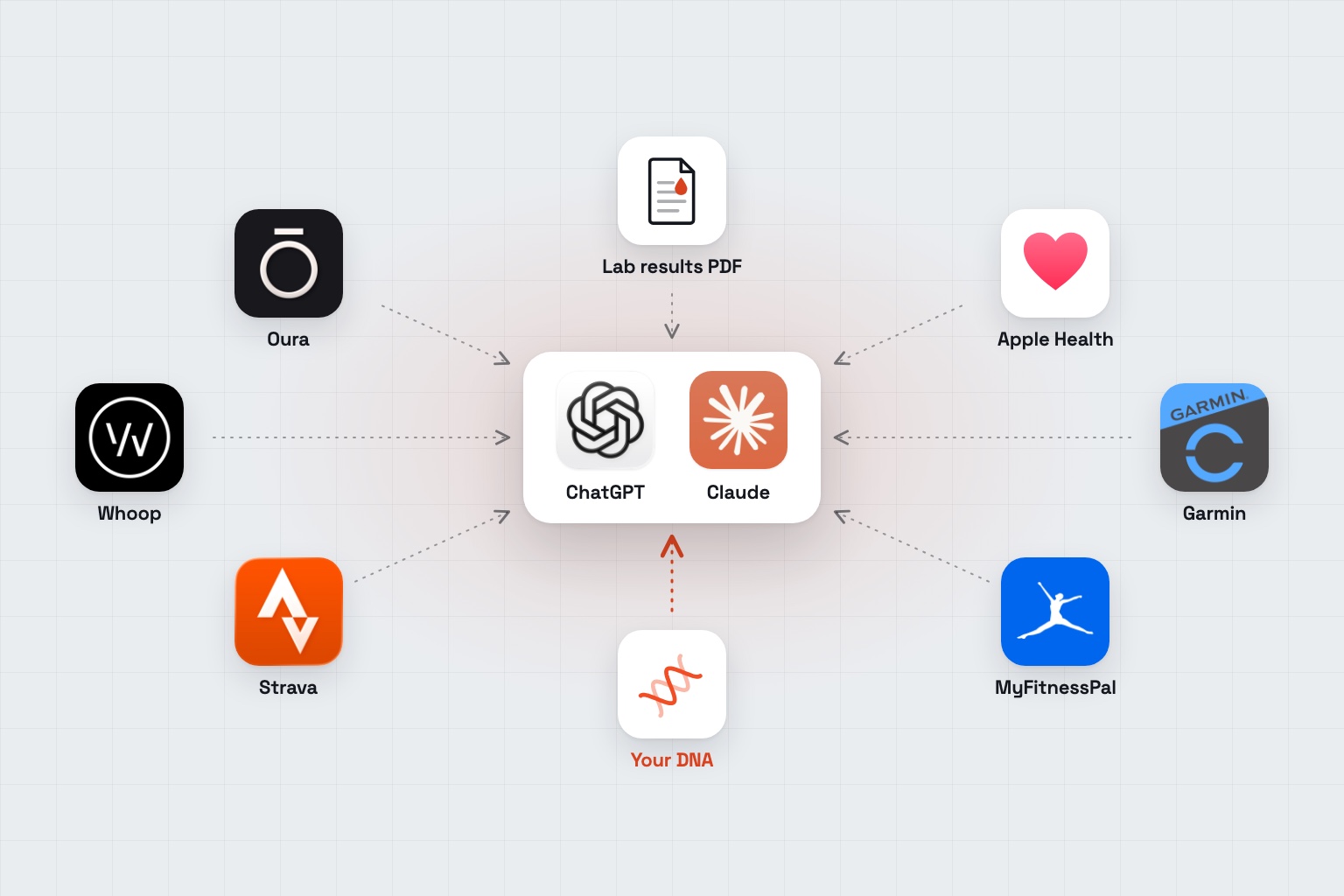
That matters for a simple reason. Every health app is a specialist that only sees its own slice of you. Your recovery score cannot see the late coffee. Your training plan cannot see three short nights. Your calorie target cannot see that this was a 40-mile week. So on the same morning the training app says go hard, the recovery app says rest, and the food app says eat less. An assistant that sees all of it can do what a good human team does: line the days up, notice what moved together, and give you one plan.
Your team
Think of it as one assistant wearing several hats, each one reading the same file on you.
The trainer looks at your workouts and how recovered you are, and plans the week around the long run, the work deadline and the bad night. "Plan my two hard sessions this week around Sunday's long run and my calendar."
The sleep and recovery coach looks at your sleep and heart rate and tells you what is probably just training load and what is worth paying attention to. "My resting heart rate has been up for five days. What is likely going on?"
The nutritionist looks at what you actually eat, whether from a food app, a photo of the plate or a few words, and at how much you trained. "Here is what I ate this week. Given my training and my results, what is missing?"
The doctor's-visit helper reads your blood test and explains it in plain words before the appointment. Attach the PDF from your lab, from any lab in any country, and ask. "Explain my last blood panel and write down five questions for my doctor." It explains and prepares; the diagnosis stays with your doctor, and the questions make that appointment better.
The genetics brief is what every member reads. Sleep, training and meals change every day; your genotype never does. It can help explain why your response differs from the average: why the same coffee keeps you up, why your hard sessions seem to need more days around them. These are leans, not verdicts, and a good report says how big each one is. But a lean that shows up in your report and again in a month of your own sleep data is worth more than either alone.
Where the pieces come from
You do not need everything at once, and you probably have most of it already.
- Your phone's health app. Apple Health and Android Health Connect already collect sleep, workouts and heart rate from most watches, rings and bands, and both ChatGPT and Claude can read them.
- Your training app. Strava connects to Claude directly. Whoop has its own AI, Whoop Coach, which already knows your recovery; give it your DNA report and it reads that too.
- Your food log, or just photos and plain words. MyFitnessPal connects to ChatGPT directly.
- Your lab results. A PDF from the lab, attached to the chat. In the US, ChatGPT and Claude can also connect lab results and records directly.
- Your DNA report. Helisoma reads your raw 23andMe, AncestryDNA or MyHeritage file in your browser, so it never leaves your device, and turns it into a report with the study behind every finding. It connects live to ChatGPT and Claude, or goes into any chat as a PDF.
Then keep one long-running chat for your health, so the team remembers what you discussed last week.
House rules
Two habits keep the answers honest. Ask where each claim came from: "is that from my workouts, my sleep, my labs or my DNA report?" And when an answer leans on your genetics, ask how big the effect is. Common variants shift odds a little, and an answer that sounds like fate deserves a follow-up.
The third rule is the one every good human team follows too: your AI explains, plans and prepares, and anything that needs a diagnosis or a prescription goes to a doctor.
Everything you connect is read-only, and you can disconnect each source on its own at any time. What you share goes to the AI company under its own privacy policy; both OpenAI and Anthropic say health data shared this way is not used to train their models.
Start with one question
You do not need the whole team on day one. Connect the one source you already look at every morning, add your DNA report, and ask the question that has been bugging you. Add the next member when a question needs it.
If the genetics brief is missing: drop your raw DNA file on helisoma.com for a free preview. The full report is $49 once, no subscription, and connects to ChatGPT, Claude, or as a PDF to Whoop Coach, so every member of your team reads from the one file about you that never changes.
Sources
- TechCrunch: OpenAI makes ChatGPT Health available to all US users (July 23, 2026).
- OpenAI: Introducing ChatGPT Health (connected apps, permissions, training policy).
- Anthropic: Claude for healthcare and life sciences (health integrations, training policy).
- Strava Support: Strava MCP Connector (the official Claude connector).