23andMe used a slice of your file for ancestry and a few reports. The rest holds your caffeine metabolism, chronotype, lactose tolerance, muscle fiber type and hundreds more studied findings. Drop the file here: your browser reads it in about a minute, and your own AI can answer questions about it.
Free 23andMe raw data analysis, no account. $49 once for the full report, no subscription.
23andMe prepares the file on request and emails you when it is ready. It is free and takes two minutes to ask for.
Ready inAbout a week, sometimes up to 30 days.zip
Request it today. 23andMe emails you when the file is ready, so bookmark this page and come back with it.
23andMe takes about a week. Leave your email and we'll send one reminder in 7 days to come back with your file. Just that one email, then we delete your address.
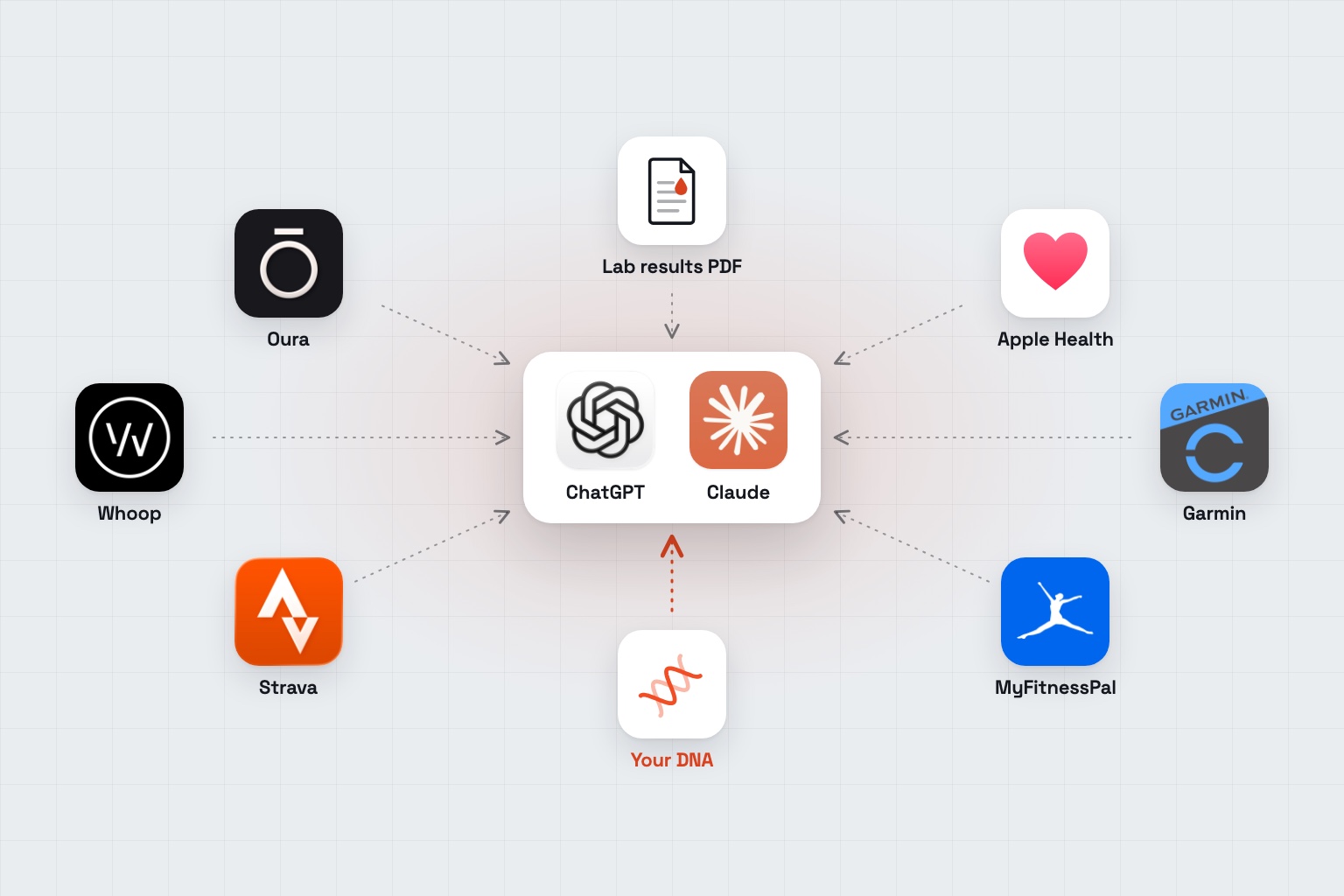
Connect your Helisoma report once and your own AI answers from your genotypes and the studies behind them: what to eat, when to train, how late to have coffee.
Questions people start with
Plan my day around my chronotype: deep work, training, last coffee
Build my yearly blood panel: what to test, when and why
Which sports fit my muscle fiber type, aerobic ceiling and injury risk?
Three findings in your report shape the answer:
Try: wake by 9am, sunlight and water first, omega-rich breakfast, coffee at 10:30, deep work 11 to 2, second block 3 to 5pm.
Want a few omega-rich breakfast recipes?
A .zip with one text file, named like genome_Your_Name_v5_Full_20260824.txt. A v5 file holds roughly 600,000 to 640,000 lines, each with the same four columns, plus a few quirks worth knowing before you search your letters online.
rs4680The variant’s public name, the one studies use. Look it up anywhere.
221 to 22, then X, Y and MT (mitochondrial).
19951271Where on that chromosome, in build 37 coordinates.
AGYour two letters, read on the plus strand. One letter on male X and Y, and on MT.
--The chip could not make a confident call here. Every file has thousands. It never means “negative”.
i300000123andMe’s own names for markers that had no public id when the chip was designed.
More: 23andMe raw data explained.
The same file that made your ancestry report holds studied markers across five areas of your life, each finding in plain words with the study behind it.
Three ways of using 23andMe raw data, starting today.
Drop the .zip in the upload box on this page. In about a minute you see findings on food, training, sleep, mind and long-term health, each with its study.
Connect the full report to ChatGPT or Claude, or attach the PDF in Gemini or Whoop Coach, and ask about your own DNA in plain words.
The file is your genome in plain text. Store it somewhere private, and only give it to tools that do not need to keep it.
No. You can’t upload raw DNA data to 23andMe: it does not accept files from other companies or tests. It only works the other way: you download your raw data from 23andMe and upload it to tools like Helisoma.
Each line has four columns: the marker id, the chromosome, the position and your two letters. On its own that tells you little, because the letters only mean something next to the study that measured them. Helisoma matches every marker against 1,190 curated evidence entries and writes the result in plain words. More in 23andMe raw data explained.
Any raw data file you download from 23andMe, whatever chip version is in the file name (v3, v4, v5). The file is read in your browser exactly as it came.
Your raw file is never uploaded at all. Your browser reads it on your device and sends only the few hundred markers the report needs, well under a megabyte. You can delete them in one click.
Yes, the analysis is free with no account: drop the file and see real findings in about a minute. The full report, every area plus the PDF and your own AI, is a one-time $49, no subscription.
What the genome_*.txt file actually contains: the four columns, the double-dash no-calls, the i-numbered markers, and the strand detail that trips up everyone who googles their letters.
Consumer DNA chips are excellent at common variants and unreliable at rare ones: a clinical lab found 40% of rare raw-data findings were false positives. Here is where the line runs and how to stay on the right side of it.
AIYour AI can be your trainer, nutritionist, sleep coach and doctor's-visit helper, all reading the same data: wearables, food log, lab results and your DNA.