 TRAIN
What can a DNA fitness test tell you about training?
You and a friend start the same running plan on the same day. Three months later, your friend has knocked minutes off a 5K. You have barely moved. Same plan, same effort, very different results.
It is tempting to blame your genes. Partly, you would be right. But the useful part of the story is what happens next.
The problem: the same training gives different results
The best evidence comes from the HERITAGE Family Study. Researchers put 481 people who didn't exercise on the same 20-week cycling program, then measured their aerobic fitness, called VO2max, the most oxygen your body can use.
Families tended to respond alike. The researchers estimated that up to 47% of the difference in how much people improved was linked to genes.
So the frustration is real. Some bodies respond fast, some slowly.
Why a DNA test can't write your plan
If training response is up to half genetic, why not just read the genes? Because that genetic part is spread across many genes, each with a tiny effect, and most of them are still unknown.
In 2015, a group of sport and exercise genetics researchers put it plainly in a consensus statement: genetic tests have no role in picking talent or in setting an individual training program. The known markers are real, but they explain only a small part of performance.
The best known is ACTN3, a protein in fast-twitch muscle fibers. About 1 in 5 people of European descent carry two copies of a version that makes none of it. Those people are rare among elite sprinters, but common among ordinary, healthy, fit people. We explain it in is there a sprinter gene?
Here is what a raw DNA file usually holds for fitness:
Which fitness markers are in your file?
Yes means the marker is in the file, counted across the files people dropped into Helisoma by November 2026. Every marker is a lean, not a verdict.
What to do: let the training dose do the work
The most hopeful study on this topic came from Zurich in 2017. Researchers split 78 healthy adults into groups that trained one to five hours a week for six weeks.
With one session a week, most people looked like "non-responders". With four or five, nobody did. And when the non-responders added two more sessions a week, every one of them improved. A slow responder is not a lost cause. They may simply need more.
Train with your genes in mind, not in charge
If your ACTN3 result leans toward endurance, that is a reason to try longer efforts first, not a reason to skip strength work.
Time a fixed run or ride now, then again after 8 to 12 weeks. That number is your real result.
One or two extra sessions a week turned every non-responder in the Zurich study into a responder.
Almost everyone benefits from both, whatever their muscle genes say.
Gains happen between sessions. See the 72 hours after a workout.
Questions people ask
Do DNA fitness tests work?
They can tell you a few real things, like which version of ACTN3 you carry. They can't pick your sport or design your training. A 2015 consensus of sport genetics researchers said genetic tests have no role in setting a training program.
What can 23andMe say about fitness genes?
A 23andMe raw data file includes ACTN3, ACE and several markers linked to aerobic capacity and strength. Read them as leans that suggest where to start.
Can AncestryDNA raw data show fitness genes?
Yes. AncestryDNA files carry ACTN3 and most other common fitness markers. MyHeritage files almost never carry ACTN3.
Can a DNA test help with muscle building?
Only a little. Markers like ACTN3 and GDF5 lean toward power or strength, but the effects are small. Training consistently and making it gradually harder matters far more than any marker.
Is there a DNA test for diet and exercise?
Many kits bundle both. Your raw file can answer a few real food questions, like milk and caffeine, and give leans on muscle type and aerobic capacity. Neither half can write your plan. For the food side, see can your DNA tell you what to eat?
Is a DNA test for athletes worth it?
Not to choose a sport or a program. Sports scientists advise against genetic tests for talent picking, especially for children. Testing your actual fitness every few months tells you far more.
About Helisoma
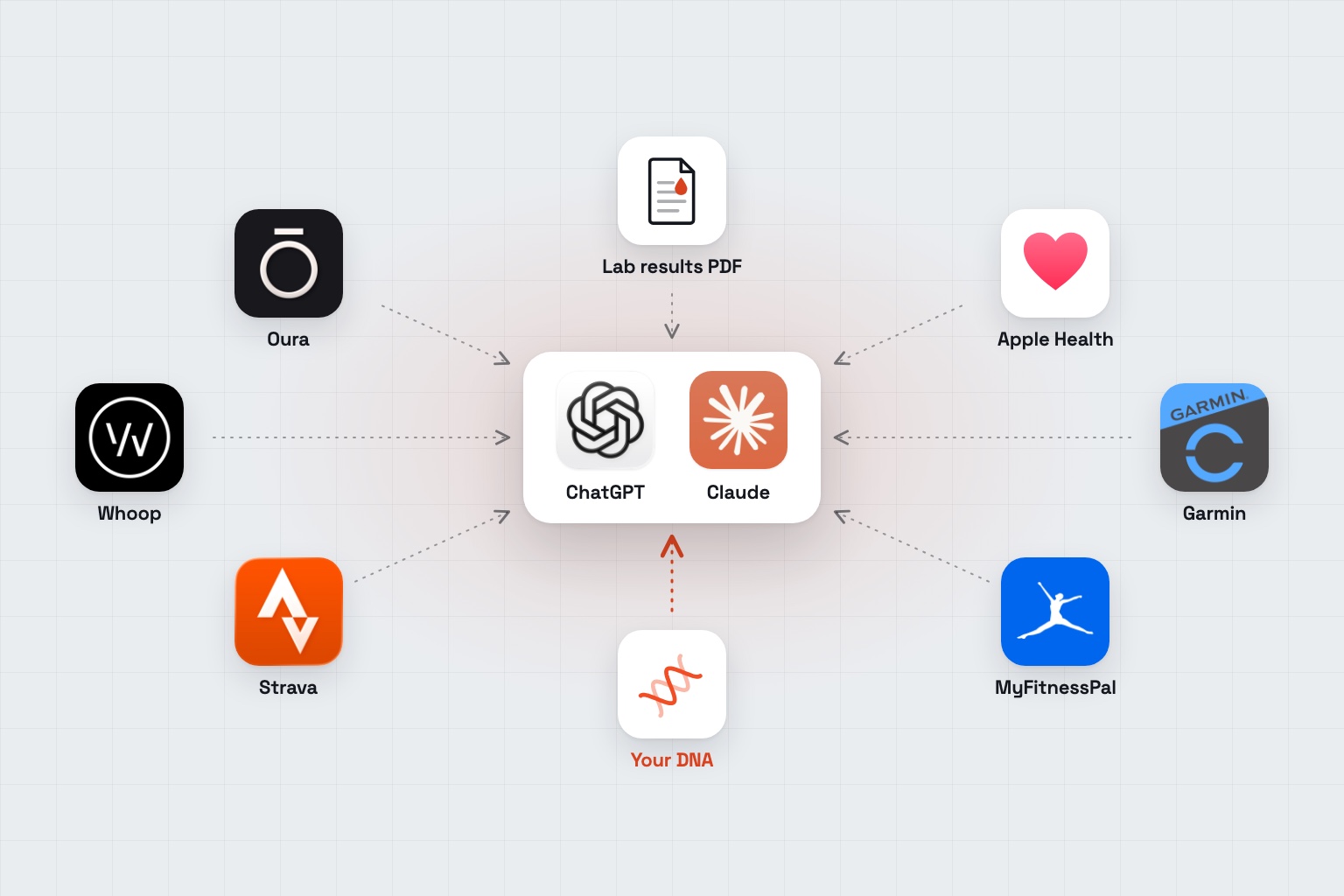
If you have a raw DNA file from 23andMe, AncestryDNA or MyHeritage, Helisoma reads it in your browser in about a minute, and the file never leaves your device. The full report, $49 once, has a Body and fitness area: muscle fiber type, aerobic capacity, strength, and tendon strain under load, each sized as the lean it is, next to your sleep and nutrition results. You can connect it to ChatGPT or Claude and ask your own AI to build a training week that fits your genes and your schedule.
Sources
- Bouchard C, An P, Rice T, et al. Familial aggregation of VO2max response to exercise training: results from the HERITAGE Family Study. Journal of Applied Physiology, 1999. PubMed 10484570
- Webborn N, Williams A, McNamee M, et al. Direct-to-consumer genetic testing for predicting sports performance and talent identification: consensus statement. British Journal of Sports Medicine, 2015. PubMed 26582191
- Yang N, MacArthur DG, Gulbin JP, et al. ACTN3 genotype is associated with human elite athletic performance. American Journal of Human Genetics, 2003. PubMed 12879365
- Montero D, Lundby C. Refuting the myth of non-response to exercise training: 'non-responders' do respond to higher dose of training. Journal of Physiology, 2017. PubMed 28133739