 FOCUS
Focus and stress: what your DNA can and can't say
Some people do their best work with a deadline breathing down their neck. Others freeze, reread the same paragraph four times and end the day with nothing done. If you are in the second group, you have probably wondered whether your brain is simply wired that way.
There is a gene with a famous answer to that question. The real answer is more useful.
The problem: the same pressure, very different brains
Focus is not one thing. It is holding a few ideas in mind at once, ignoring the noise, and staying on one task long enough to finish it. Stress changes all three, and it changes them differently for different people.
That is why the idea of a focus gene is so appealing. If you knew your type, you could stop fighting it.
Why it happens: dopamine has a sweet spot
The front of your brain, the prefrontal cortex, runs on dopamine. Too little and your thoughts drift. Too much and they scatter. Researchers call this the inverted U: focus is best in the middle.
COMT is the enzyme that clears dopamine from the prefrontal cortex. A common variant builds a slower version. The theory goes like this: with slow COMT you have more dopamine at rest, which helps calm focus but leaves less room before stress tips you over the top of the curve. With fast COMT you start lower, so a bit of pressure can actually help. Hence the nicknames, "worrier" for slow and "warrior" for fast.
It is a neat story. When researchers pooled 27 studies with 15,979 people, the link between COMT and anxiety-related traits was small and inconsistent: no link at all in women, and in white men it ran the opposite way from the theory. We dug into it in are you a warrior or a worrier?
BDNF, a growth factor that helps brain cells strengthen connections, has a similar story. Early small studies tied a common variant to memory. Larger studies didn't confirm it. More in BDNF and the genetics of remembering.
The third gene worth knowing is ADORA2A, the receptor caffeine blocks. It is linked to how jittery coffee makes you, which matters a lot for focus. See why coffee makes some people anxious.
Are your focus and stress genes in your file?
Yes means the marker is in the file, counted across the files people dropped into Helisoma by November 2026. Each one is a small lean.
What moves focus far more: sleep
A review of 70 studies on short sleep loss found its biggest effect on simple attention: people kept "blanking out" on easy tasks. Working memory and processing speed suffered too.
No focus gene comes close to that.
What to do: work with your brain, not against it
Better focus under pressure
It is the biggest lever on attention, far bigger than any gene.
Caffeine improves attention, but if coffee makes you jittery, a smaller dose earlier works better than a big one when stress is already high.
Night owls and early birds peak at different times. See night owl or early bird.
Step away from the screen for a few minutes between blocks of deep work.
Fewer open tabs, one task at a time, and a clear next step take pressure off before it builds.
If stress or worry is affecting your life, not just your work, that is worth talking to a doctor or therapist about. Your genes don't decide how that goes.
Questions people ask
Is there a gene for focus?
Not one. COMT, BDNF and others each play a small part in attention and working memory, but large studies show the effects are small. Sleep, stress and habits matter much more.
What is the warrior or worrier gene?
It is COMT, the enzyme that clears dopamine in the front of the brain. The slow version was nicknamed "worrier" and the fast one "warrior", but a pooled analysis of 27 studies found the link to anxiety small and inconsistent.
Can 23andMe or AncestryDNA raw data show COMT?
Yes. The COMT marker, rs4680, is in essentially every 23andMe, AncestryDNA and MyHeritage file we have read.
Does stress affect focus differently depending on genes?
Possibly a little. The COMT theory says slow-COMT carriers tip over sooner under heavy stress, but the evidence is mixed. Everyone's focus drops under severe stress and short sleep.
About Helisoma
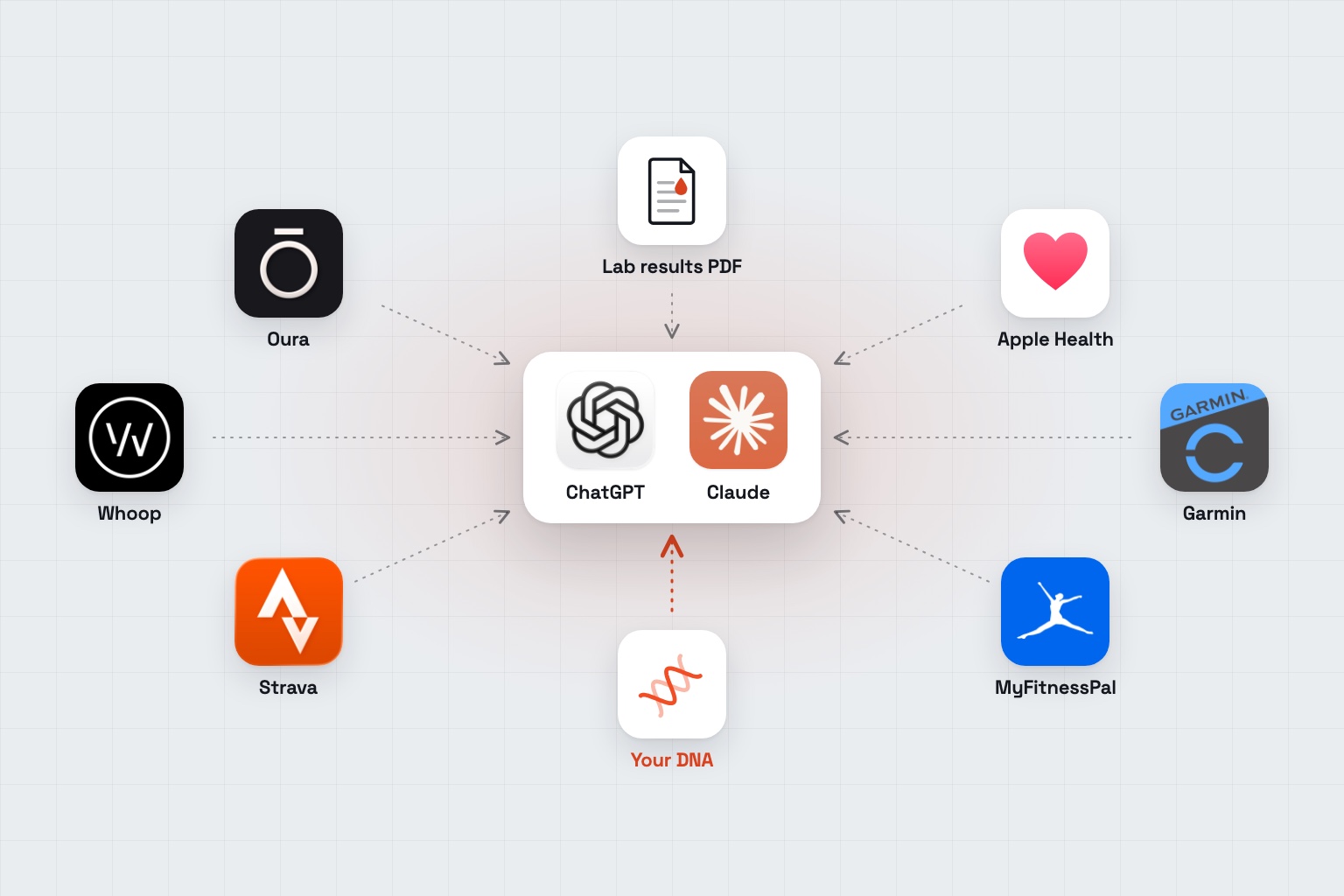
If you have a raw DNA file from 23andMe, AncestryDNA or MyHeritage, Helisoma reads it in your browser in about a minute, and the file never leaves your device. The full report, $49 once, has a Brain and mind area: COMT, BDNF, caffeine sensitivity and mood markers, each sized honestly with the study behind it, next to your sleep and chronotype results. You can connect it to ChatGPT or Claude and ask your own AI to plan a workday around your energy, caffeine and sleep.
Sources
- Cools R, D'Esposito M. Inverted-U-shaped dopamine actions on human working memory and cognitive control. Biological Psychiatry, 2011. PubMed 21531388
- Lee LO, Prescott CA. Association of the catechol-O-methyltransferase val158met polymorphism and anxiety-related traits: a meta-analysis. Psychiatric Genetics, 2014. PubMed 24300663
- Lim J, Dinges DF. A meta-analysis of the impact of short-term sleep deprivation on cognitive variables. Psychological Bulletin, 2010. PubMed 20438143
- McLellan TM, Caldwell JA, Lieberman HR. A review of caffeine's effects on cognitive, physical and occupational performance. Neuroscience and Biobehavioral Reviews, 2016. PubMed 27612937