 HLTH
Does AncestryDNA tell you anything about your health?
You spat in the tube, mailed it off and waited six weeks. Back came a pie chart, a map and a list of third cousins. Not one word about your health. Your friend who did 23andMe got reports on caffeine, lactose and sleep. So did your test simply not look?
It did look. It just doesn't show you.
The problem: your test read your health markers and shows you none
AncestryDNA and 23andMe use the same kind of test: a DNA chip. A chip does not read your whole genome. It checks hundreds of thousands of chosen spots where people commonly differ, and records your two letters at each one.
Ancestry uses those spots to place you on a map and find your relatives. But common differences are also what most wellness research studies, because the large DNA studies look at exactly these spots. So your AncestryDNA file contains markers like CYP1A2, the liver enzyme that clears caffeine, and LCT, the switch that decides whether adults keep digesting milk.
23andMe sells a Health + Ancestry kit that turns some of those markers into health reports. Ancestry once did the same, for about a year and a half.
Today an AncestryDNA kit gives you ethnicity and relatives, and nothing else, in the app.
Why it happens: Ancestry chose family history, and the data stayed
When Ancestry closed AncestryHealth, it said it would focus on its family history business. That was a business decision. Nothing about the test itself changed. The chip still reads the same markers, and they all land in your raw data file, which Ancestry lets you download at any time.
The file is not small. Across the AncestryDNA files people have dropped into Helisoma, the average held about 640,000 markers. A 23andMe file holds about 700,000. Same kind of data, roughly the same size.
So the data is there. The fair next question is how far you can trust it. The answer depends less on the brand of the kit than on what kind of variant you are asking about.
Common variants, the kind behind caffeine, milk or muscle type, are read almost perfectly. Very rare variants, the kind behind serious inherited diseases, are where chips fail. So if any tool tells you your AncestryDNA file shows a serious medical variant, treat it as a question for a doctor, not an answer.
That one rule tells you how to use the file.
What to do: download your file and read it with care
Get health insights from your AncestryDNA test
Sign in at ancestry.com, open DNA Settings and choose "Download DNA data". Ancestry emails you a link, usually within minutes, at most a day. The link works once and expires after a week, so use it when it arrives. Our AncestryDNA guide shows each click.
It is a .zip with one text file inside, AncestryDNA.txt. It is your genome, so store it like a passport scan. Don't paste it into a chatbot. Here is why.
The checker below shows which ones your file can answer.
A good one names the study behind every finding, says how big the effect is, and doesn't sell you supplements based on one gene.
Family history and a clinical test beat any raw file for disease risk.
Not every test reads every marker, so it is worth checking before you expect an answer. Pick your test:
Which questions can your file answer?
Yes means the marker is in the file, counted across the files people dropped into Helisoma by November 2026. Even a Yes gives a lean, not a verdict.
Two results surprised us. AncestryDNA files carry about twice as many clock-gene markers as 23andMe files, so for the night owl question an Ancestry file is the better one to have. And MyHeritage files almost never include ACTN3, the best-known muscle marker.
Remember what a lean is: a small push one way. Your sleep, diet and training usually matter more than any single marker, and a good report says so on every finding.
For what else the file is good for, including matches and privacy, see what to do with your AncestryDNA results.
Questions people ask
Does AncestryDNA have a health report?
No. The AncestryDNA app shows ethnicity estimates and DNA matches only. Ancestry's health report, AncestryHealth, stopped selling in January 2021 and its reports went offline later that year.
Is there an AncestryDNA health and ancestry test?
Not anymore. As of November 2026, Ancestry sells no health version of its kit. If you already took an AncestryDNA test, you don't need a new kit for health: the markers are in your raw data file.
Can I get a health analysis from my AncestryDNA raw data?
Yes, for everyday wellness questions. Download the raw data from DNA Settings and open it with a tool that reads AncestryDNA files. Expect leans about caffeine, milk, alcohol, omega-3, muscle type and sleep timing, not diagnoses.
Can AncestryDNA raw data help with my diet?
Partly. It can show whether you likely digest milk as an adult, how fast you clear caffeine, whether alcohol makes you flush and how well you convert plant omega-3. It can't pick a diet for you: what you eat, how much and how you sleep matter more.
Can AncestryDNA show medical conditions?
No. A consumer chip is unreliable for the rare variants behind serious inherited diseases, and false alarms are common. For medical questions, talk to a doctor about a clinical test.
How Helisoma reads your AncestryDNA file
That gap, a file full of health markers and an app that shows none of them, is why we built Helisoma.
You drop your AncestryDNA file, still zipped, and your browser reads it on your own device in about a minute. The file never leaves it: only the few hundred markers the report needs are sent to us. Your first findings appear right away, free, with no account.
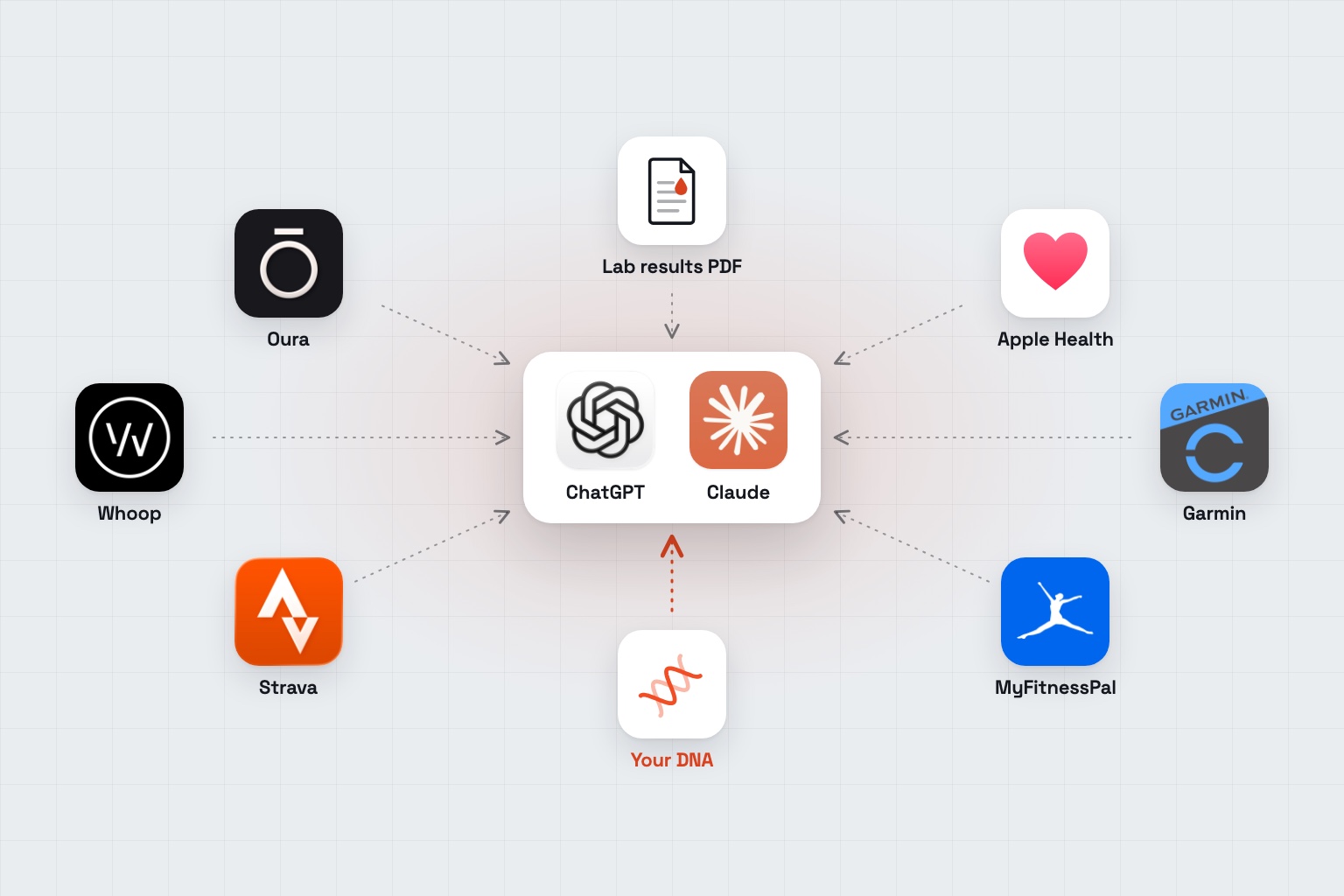
The full report is $49 once, with no subscription. It covers nutrition, fitness, sleep, mind and longevity, and every finding names its study and is sized as the small lean it is. You also get a PDF, and you can connect the report to ChatGPT or Claude and ask your own AI what to change first. We leave rare disease variants out on purpose, for the reasons above.
Sources
- Weedon MN, Jackson L, Harrison JW, et al. Use of SNP chips to detect rare pathogenic variants: retrospective, population based diagnostic evaluation. BMJ, 2021. PubMed 33589468
- Tandy-Connor S, Guiltinan J, Krempely K, et al. False-positive results released by direct-to-consumer genetic tests highlight the importance of clinical confirmation testing for appropriate patient care. Genetics in Medicine, 2018. PubMed 29565420
- Bloomberg. Ancestry pulling health DNA test just over a year after launch. January 14, 2021. bloomberg.com
- Family Tree Magazine. Which DNA health test is best? (on the end of AncestryHealth in 2021). familytreemagazine.com
- Ancestry Support. Downloading DNA Data. ancestry.com