 3RD PARTY
What is third-party DNA analysis, and is it worth it?
You took a DNA test, looked at the results once and closed the app. Somewhere along the way you saw that you can "download your raw data", and that other sites can read it. That is third-party DNA analysis. It sounds technical and a little risky, so here is what it actually is.
The problem: your test reads far more than it shows you
A consumer DNA test reads about 600,000 to 700,000 positions in your genome. The company then shows you a small slice of that: an ethnicity estimate, a list of relatives, and sometimes a few health reports.
AncestryDNA shows no health results at all, since Ancestry closed its health product in 2021. 23andMe shows health reports only on its more expensive kit. The rest of the data sits unused in a file you are allowed to download. We explain the Ancestry side in does AncestryDNA tell you anything about your health?
How it works
The raw file is a plain text list of markers, each with your two letters. Any service that knows which markers matter for a question can read it. That is why so many services exist: the file is the same, but the questions they answer are different.
What third-party services usually offer
| Type of service | What it reads in your file | Good for |
|---|---|---|
| Health and wellness reports | Markers studied for caffeine, lactose, sleep, fitness, vitamins | Everyday choices: food, training, sleep |
| Relative matching | Long shared stretches of DNA with other users | Finding family. Your file joins their database |
| Raw lookup tools | Any marker you type in | Curious readers who can decode research papers |
| AI assistants | A report built from your file | Turning results into a plan you can ask questions about |
Is it accurate?
It depends on what you look at. A study of 49,908 people compared chip results with full sequencing. For common variants, the chip was right more than 99% of the time. For very rare variants, only about 1 in 6 chip calls held up.
So third-party analysis is reliable for common, well-studied wellness markers like caffeine, milk or muscle type. It is not a way to find rare disease genes. If a service tells you your raw file shows a serious medical mutation, take it to a doctor for a clinical test before you believe it.
Is it safe?
Safety comes down to two questions: where your file is read, and how long it is kept.
- Where it is read. Most services upload your whole file to their servers. A few read it inside your browser, so the full file never leaves your device.
- How long it is kept. Some services delete the file within a day. Others keep it as long as your account exists.
- Relative-matching sites work differently. Your data is meant to be shared with other users, which is the point of the service.
We wrote a five-minute checklist for any site: does a DNA site keep your raw data?
What to do: choosing a third-party service
Use your raw data the smart way
Every major test lets you. Our download guide shows where to click for each company.
Health and habits, relatives, or a specific gene. Different services answer different questions.
Check where the file is read, how long it is kept and whether you can delete it.
A good report shows the study behind each finding and says how big the effect is.
Some services charge once, others charge a monthly subscription for the same file.
Questions people ask
What is third-party DNA analysis?
It means using a different service to read the raw data from your DNA test. You download the file from 23andMe, AncestryDNA or MyHeritage, then upload it or open it with another service that gives you new reports.
Is third-party DNA analysis safe?
It can be. Choose a service that reads the file in your browser or deletes it soon after processing, lets you delete your data yourself, and doesn't sell genetic data. Avoid services that are vague about how long they keep your file.
Is third-party DNA analysis accurate?
For common variants, yes: chips agree with full sequencing more than 99% of the time. For very rare variants, no: most rare "findings" in a raw file are chip errors.
Can I use my 23andMe raw data for third-party analysis?
Yes. 23andMe lets you download your raw data, and the file works with most third-party services. The same is true for AncestryDNA and MyHeritage files.
Is third-party DNA analysis free?
Some basic tools are free. Fuller health reports usually cost a one-time fee or a subscription. Check what you get before you pay, and whether the price repeats.
About Helisoma
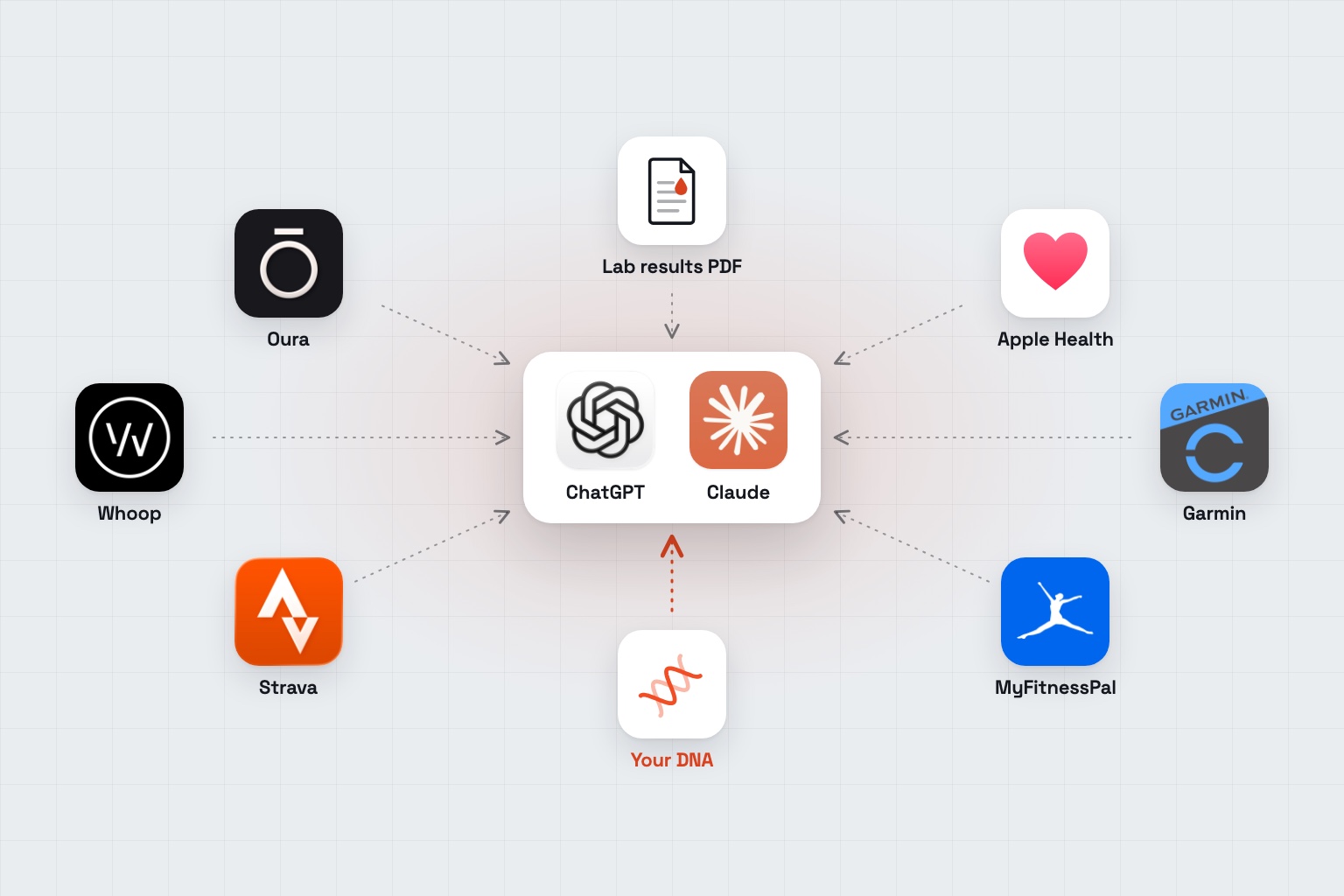
Helisoma is a third-party DNA analysis service built around two of the questions above. Your browser reads your 23andMe, AncestryDNA or MyHeritage file on your own device in about a minute, and the file is never uploaded. Only the few hundred markers the report needs are sent to us. The free first look shows your strongest findings. The full report is $49 once, with no subscription, and covers nutrition, fitness, sleep, mind and longevity, with the study behind every finding. You can also connect it to ChatGPT or Claude and ask your own AI what to do with it.
Sources
- Weedon MN, Jackson L, Harrison JW, et al. Use of SNP chips to detect rare pathogenic variants: retrospective, population based diagnostic evaluation. BMJ, 2021. PubMed 33589468
- Bloomberg. Ancestry pulling health DNA test just over a year after launch. January 14, 2021. bloomberg.com