 ADORA2A
Why coffee makes some people anxious (it is not how fast you clear it)
Your colleague has a double espresso at four and sleeps like a baby. You have one cappuccino at nine, and by ten your heart is racing, your hands feel buzzy and a small worry has turned into a big one.
Most articles will tell you that you are a "slow caffeine metabolizer". That is often the wrong explanation.
The problem: one cup, and your body thinks something is wrong
Caffeine anxiety feels physical. A faster heartbeat, a tight chest, restless legs, a mind that won't settle. For some people it shows up after a single cup. For others it takes four.
It is easy to conclude you can't handle coffee at all. Usually that is not true. You just need to know which part of the caffeine story is yours.
Why it happens: caffeine works on a brake in your brain
During the day your brain builds up a chemical called adenosine. It acts like a brake: the more of it, the sleepier and calmer you feel. Caffeine works by blocking one of the receptors adenosine uses, called A2A. Brake off, and you feel alert.
The gene for that receptor is ADORA2A. People carry slightly different versions of it, and some versions seem to make the brake easier to switch off.
In that University of Chicago study, people with certain ADORA2A versions reported more anxiety after a moderate dose than people with other versions. A larger British study of 379 people found the same link with the T/T version, and a second important thing: people who drink coffee regularly reacted less, whatever their genes. Tolerance is real.
A Swiss study found the same ADORA2A variant was more common in people who said caffeine ruins their sleep, and it shaped how much caffeine changed their brain waves during sleep.
The other caffeine gene
CYP1A2 is the liver enzyme that clears caffeine. It decides how long caffeine stays in your blood, which matters most for sleep. We wrote about it in is there a caffeine gene?
Put the two together and you get four kinds of coffee drinker:
Both genes are leans, not switches. Dose, sleep, stress and how often you drink coffee matter as much as either one.
Are your caffeine genes in your file?
Yes means at least one of the markers is in the file, counted across the files people dropped into Helisoma by November 2026.
What to do: keep the coffee, lose the jitters
Coffee without the anxiety
In the Chicago study, the gene made a difference at about a large mug, and the lowest dose didn't raise anxiety. A single espresso or a small cup is often enough to stay alert.
Regular drinkers reacted less in the British study, so occasional big doses tend to hit harder than a steady habit.
A cup of black tea has about half the caffeine of filter coffee.
If you also clear caffeine slowly, an afternoon cup can still be in you at bedtime. Try our caffeine calculator.
Energy drinks, pre-workout, cola and chocolate add up. The FDA puts 400 mg a day as an amount not generally linked to harm for healthy adults, but sensitive people feel much less.
If anxiety is part of your life with or without coffee, cutting caffeine helps, but it is worth talking to a doctor too. We looked at the bigger picture in is anxiety genetic?
Questions people ask
Why does coffee make me anxious?
Caffeine blocks the brain's adenosine A2A receptors, which act like a brake on alertness. Some people's version of the receptor gene, ADORA2A, is linked to stronger jitters after a moderate dose. Dose and how often you drink coffee matter as much as the gene.
Is caffeine sensitivity genetic?
Partly. Caffeine and genetics have been studied together for over twenty years. Two genes stand out: ADORA2A, linked to how strongly you feel caffeine, and CYP1A2, linked to how fast you clear it. Both are small leans, and regular coffee drinking reduces the anxiety response.
What gene metabolizes caffeine?
CYP1A2, a liver enzyme, clears most of the caffeine you drink. Its versions lean toward fast or slow clearing. We cover it in is there a caffeine gene?
Am I a slow caffeine metabolizer if coffee makes me anxious?
Not necessarily. Jitters are mostly about how your brain reacts, while slow clearing mostly affects sleep. You can be a fast clearer and still feel very jittery.
Can 23andMe or AncestryDNA show caffeine sensitivity?
Yes, in most files, so you don't need separate genetic testing for caffeine sensitivity. 23andMe files carry the ADORA2A and CYP1A2 markers, and most AncestryDNA and MyHeritage files carry them or close stand-ins.
About Helisoma
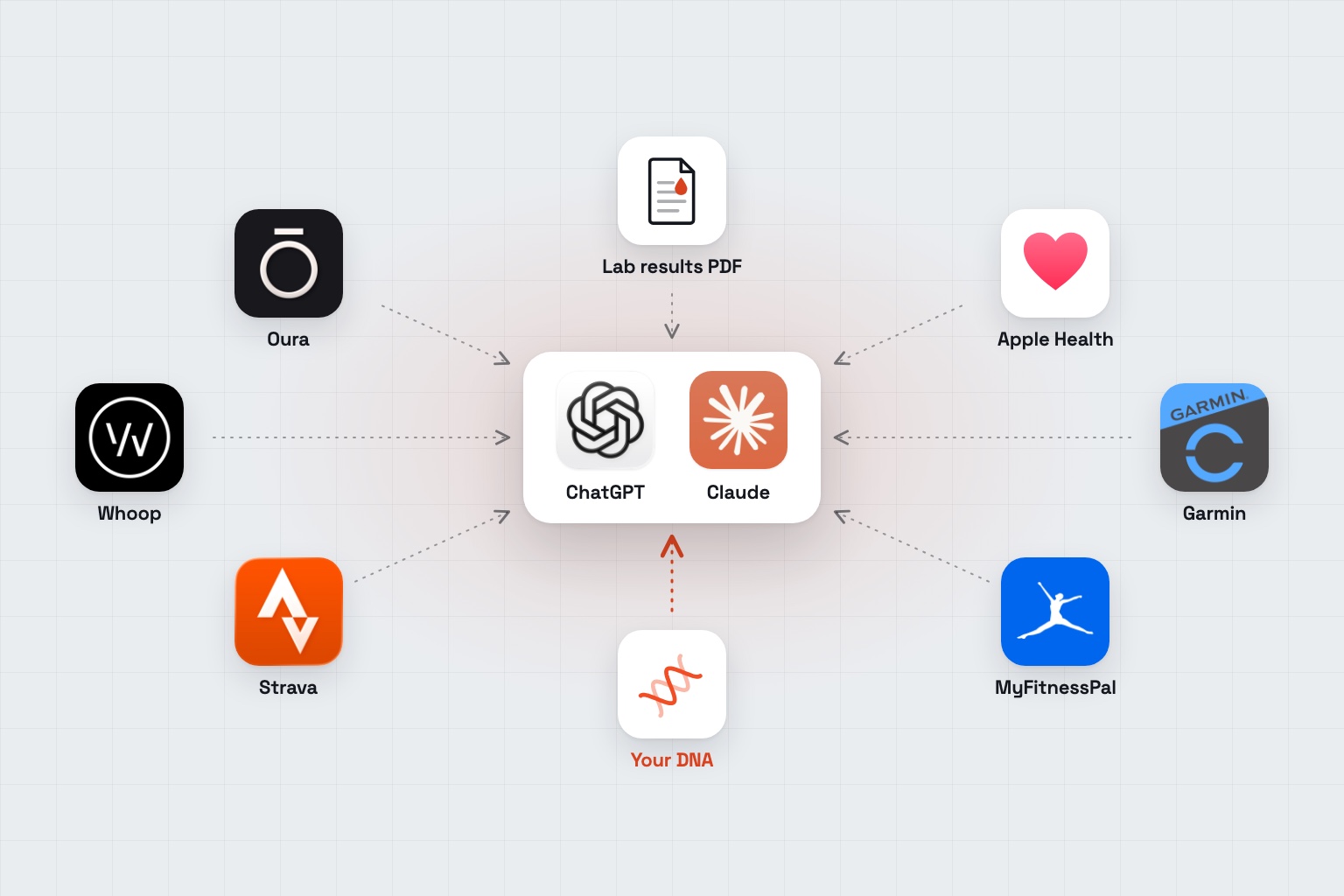
If you have a raw DNA file from 23andMe, AncestryDNA or MyHeritage, Helisoma reads it in your browser in about a minute, and the file never leaves your device. The full report, $49 once, shows both caffeine genes side by side: how strongly you feel caffeine and how long it stays, plus how late a coffee can be before it costs you sleep. It sits next to your sleep and stress results. You can connect it to ChatGPT or Claude and ask your own AI when your last coffee of the day should be.
Sources
- Childs E, Hohoff C, Deckert J, et al. Association between ADORA2A and DRD2 polymorphisms and caffeine-induced anxiety. Neuropsychopharmacology, 2008. PubMed 18305461
- Rogers PJ, Hohoff C, Heatherley SV, et al. Association of the anxiogenic and alerting effects of caffeine with ADORA2A and ADORA1 polymorphisms and habitual level of caffeine consumption. Neuropsychopharmacology, 2010. PubMed 20520601
- Alsene K, Deckert J, Sand P, de Wit H. Association between A2a receptor gene polymorphisms and caffeine-induced anxiety. Neuropsychopharmacology, 2003. PubMed 12825092
- Rétey JV, Adam M, Khatami R, et al. A genetic variation in the adenosine A2A receptor gene (ADORA2A) contributes to individual sensitivity to caffeine effects on sleep. Clinical Pharmacology and Therapeutics, 2007. PubMed 17329997
- US Food and Drug Administration. Spilling the beans: how much caffeine is too much? fda.gov