 ALLERGY
Can your raw DNA show food allergies?
Your stomach turns after pizza. Your face goes hot after wine. Your lips tingled once after a cookie, and you never found out why. You already have a DNA file from 23andMe or AncestryDNA. Surely the answer is in there?
Partly. But probably not the part you expect.
The problem: many food reactions, one confusing word
People use "allergy" for almost any bad reaction to food. A large US survey of 40,443 adults showed how far that goes.
So a lot of people are avoiding foods they could eat, and some are missing a real allergy that needs care. The most common real ones in adults were shellfish (2.9%), milk (1.9%), peanut (1.8%), tree nuts (1.2%) and fish (0.9%). Nearly half of adults with a food allergy developed it as adults.
Why your DNA can't diagnose an allergy
A food allergy is an immune reaction. Your body makes antibodies called IgE against a food protein, and the next time you eat it, those antibodies set off hives, swelling, vomiting or, in the worst case, anaphylaxis.
Genes play a part in who develops allergies, but no single marker in a consumer DNA file says "allergic to peanuts". The US expert guidelines on food allergy diagnose it from three things: your history, IgE tests, and when needed an oral food challenge done by a doctor. DNA is not on that list.
What a DNA file can do is explain reactions that are not allergies at all:
| Reaction | What causes it | Can your DNA show it? |
|---|---|---|
| Hives, swelling, throat tightness after a food | Food allergy, an immune reaction | No. See an allergist |
| Bloating and cramps after milk | Lactose intolerance, the gut stops making lactase | Yes, the LCT lactase switch. More |
| Red face and racing heart after alcohol | Alcohol flush, often called an Asian alcohol allergy: acetaldehyde builds up | Yes, ALDH2. More |
| Gut trouble after gluten | Celiac disease, an autoimmune condition | No. Diagnosed with a blood test and a biopsy |
Celiac disease has genes linked to it, but genes alone can't diagnose it. About 1.4% of people worldwide test positive on the celiac blood test.
Are the food-reaction genes in your file?
Yes means the marker is in the file, counted across the files people dropped into Helisoma by November 2026.
What to do: sort out which reaction you have
From a bad reaction to a clear answer
Which food, how much, how fast the reaction came and what it looked like. Allergies usually strike within minutes to two hours.
Swelling of the lips or throat, trouble breathing or fainting after food needs urgent care, then an allergist.
If it says your lactase switch is likely off, try a week of lactose-free milk and see if the bloating goes.
A flush is not an allergy, but it is a reason to drink less, not to push through it.
For a suspected allergy, an allergist's IgE tests and a supervised challenge are the standard.
Questions people ask
Can 23andMe show food allergies or food sensitivities?
No. 23andMe raw data doesn't include a test for food allergies, which are diagnosed with IgE skin or blood tests. It can show lactose intolerance genes and the alcohol flush variant.
Is there a genetic test for lactose intolerance?
Yes. The lactose intolerant gene version, at the LCT lactase switch, is in 23andMe, AncestryDNA and MyHeritage raw files, so the raw file works as a lactose intolerance genetic test. More in the lactase switch.
Is the Asian alcohol allergy a real allergy?
No. The red face, warmth and racing heart come from the alcohol flush: a common ALDH2 variant slows the clearing of acetaldehyde. It is not an immune reaction, but it is a reason to drink less. See the alcohol flush.
Is lactose intolerance an allergy?
No. Lactose intolerance means your gut makes less lactase, the enzyme that breaks down milk sugar. A milk allergy is an immune reaction to milk proteins and can be dangerous.
Can a DNA test show gluten intolerance or celiac disease?
Not on its own. Celiac disease has linked genes, but it is diagnosed with a blood test and a biopsy, done while you are still eating gluten.
Are food allergies genetic?
Partly. They run in families, but many genes and environmental factors are involved, and no single marker predicts them. Nearly half of adults with a food allergy developed it as adults.
About Helisoma
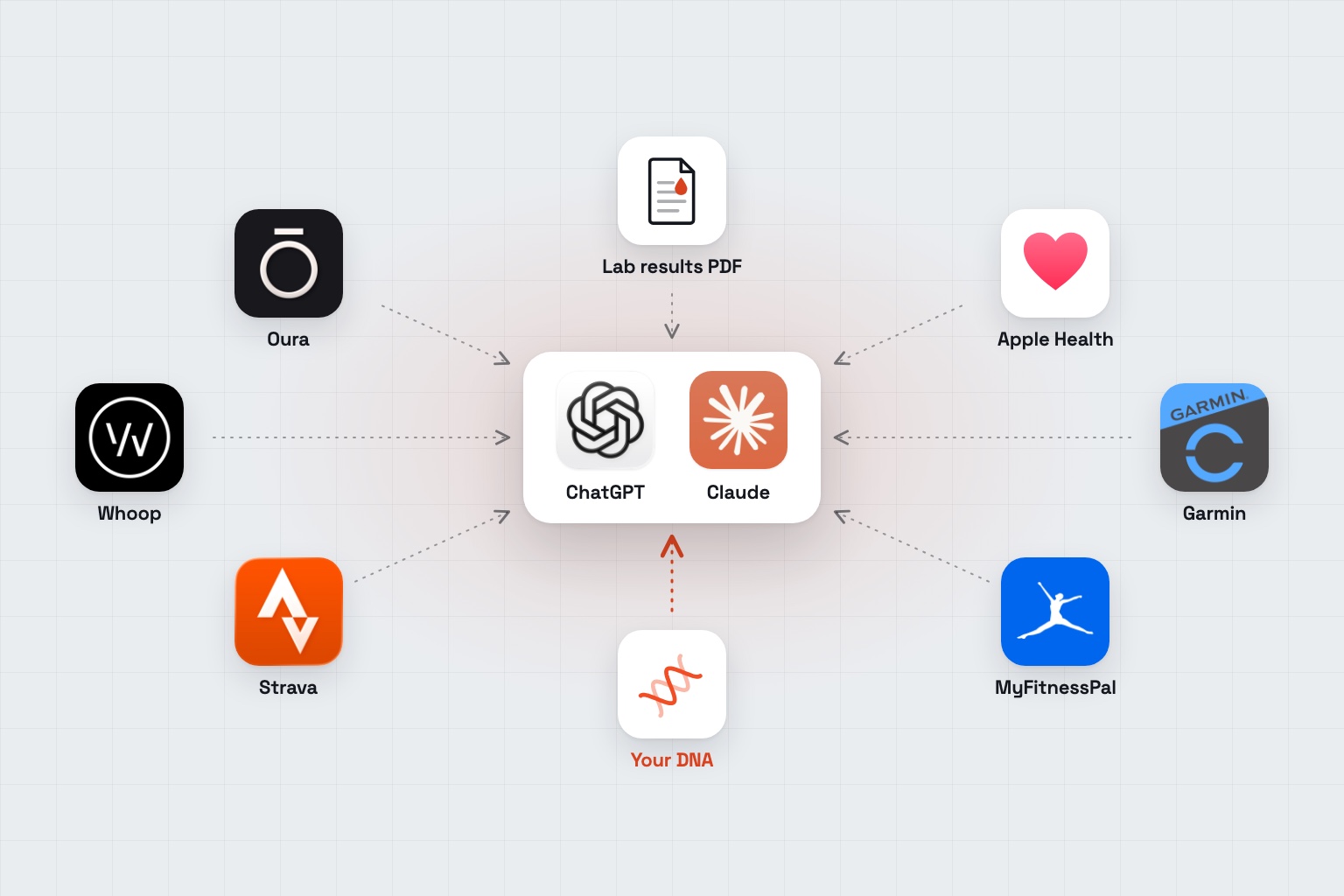
If you have a raw DNA file from 23andMe, AncestryDNA or MyHeritage, Helisoma reads it in your browser in about a minute, and the file never leaves your device. The full report, $49 once, includes your lactose tolerance and alcohol flush results in plain words, along with caffeine, omega-3 and vitamin markers, each with the study behind it. We don't report food allergies or celiac, because a raw file can't answer those. You can connect your report to ChatGPT or Claude and ask your own AI to plan meals around it.
Sources
- Gupta RS, Warren CM, Smith BM, et al. Prevalence and severity of food allergies among US adults. JAMA Network Open, 2019. PubMed 30646188
- NIAID-Sponsored Expert Panel. Guidelines for the diagnosis and management of food allergy in the United States. Journal of Allergy and Clinical Immunology, 2010. PubMed 21134576
- Singh P, Arora A, Strand TA, et al. Global prevalence of celiac disease: systematic review and meta-analysis. Clinical Gastroenterology and Hepatology, 2018. PubMed 29551598